

LEADERSHIP · IDEAS
Most organizations don’t have a people problem. They have a systems problem. Jon Orozco argues that companies become stuck because their organizational architecture was built for a different stage of growth, a different market, and a different era of technology. As the co-founder of FYHR and FYS Labs and creator of the People Systems framework, he explains why organizational design, intelligent operating systems, and disciplined execution, not technology alone, will define the winners of the Ai era.
By Rafael Magaña · August 4, 2026 · ~8 minute read
EDITORIAL · RECORD №00102 · MMXXVI
Reported, Summer 2026.
IN BRIEF
- Most organizations are not broken. They are unfinished, built for a size they no longer are. Sustainable growth requires redesigning the systems that govern how work gets done, not simply adding more people or technology.
- People Systems is an operating model, not a department. Human Resources, Finance, Information Technology, and Operations already shape one another’s decisions. The competitive advantage comes from designing those connections intentionally.
- Ai does not fix weak organizations. It amplifies them. Well-designed systems become faster and more effective. Poorly designed systems become more visible, more expensive, and more difficult to manage. That reality is reflected in MIT Media Lab’s 2025 finding that roughly 95 percent of corporate generative-Ai pilots produced no measurable return.
- Jon Orozco is the co-founder of FYHR and creator of the People Systems framework. His work spans startups, nonprofits, public institutions, and private enterprise, where he advises leaders on organizational architecture, strategy, systems design, and the integration of people, technology, and business operations.
- The future of work belongs to systems thinkers. Orozco believes Latino professionals bring a unique perspective shaped by navigating complex institutions, but argues that lasting influence will come not only through representation, but through designing the organizations, technologies, and operating systems that define the next generation of work.
Some conversations reinforce what you already believe. Others force you to rethink the assumptions you’ve carried for years. A recent conversation with Jon Orozco, co-founder of FYHR and creator of the People Systems framework, did exactly that.
Having advised and operated inside startups, nonprofits, public institutions, and growing private companies, Orozco has spent his career where strategy, operations, technology, finance, and workforce design converge. His conclusion is surprisingly straightforward: organizations succeed or fail less because of individual functions than because of the quality of the system connecting them.
This perspective forms the foundation of his People Systems framework, which treats the organization itself as an integrated operating system rather than a collection of departments. In an era dominated by Ai, Orozco argues that the companies creating durable competitive advantage will not be those with the most technology, but those with the best-designed organizational architecture.
HR is not a department. It is an operating system.
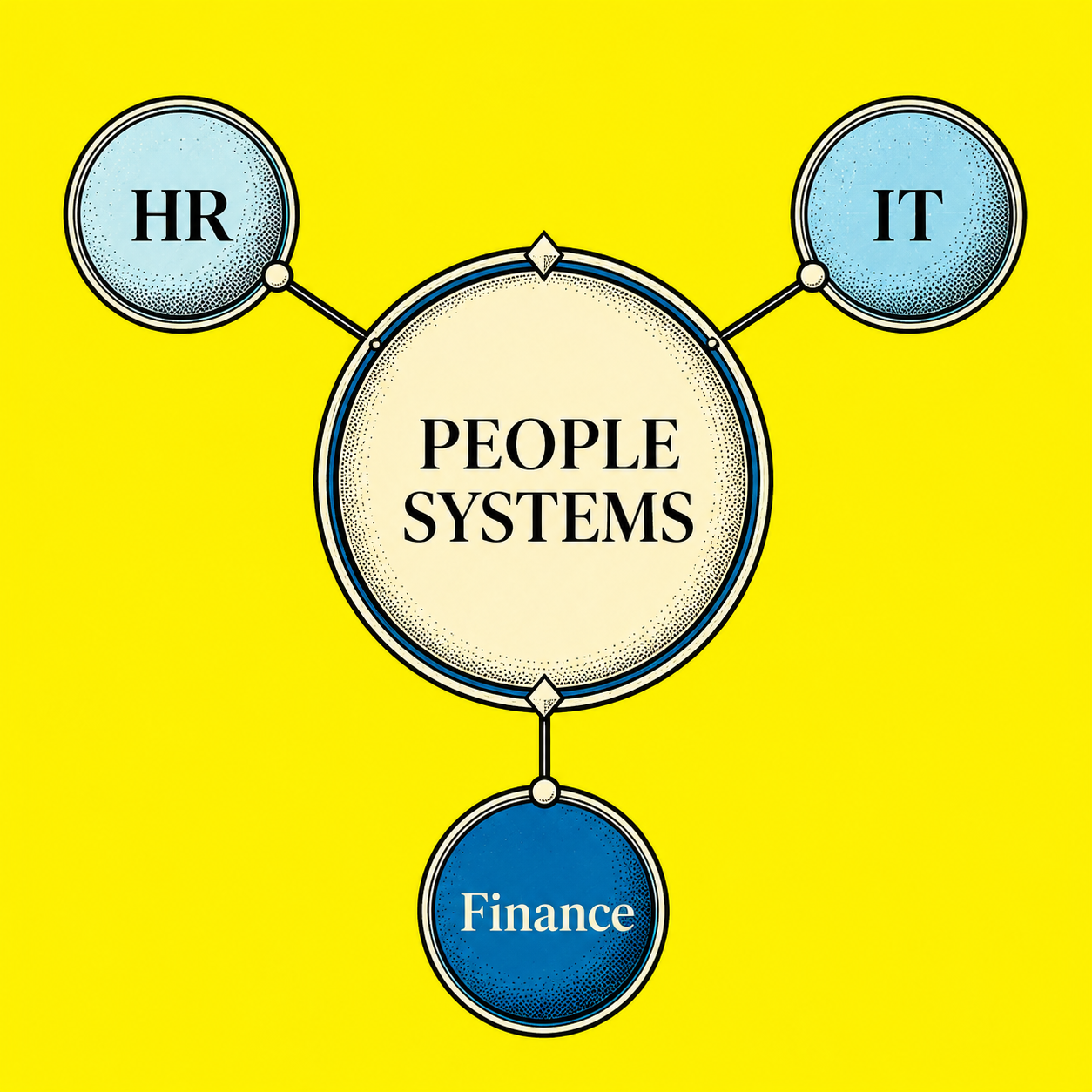
He means that literally.
Every leadership decision shapes behavior. Compensation influences financial outcomes. Technology determines how work flows through an organization. Organizational structure defines accountability, authority, and the speed of decision-making. None of these functions operate independently. When they fall out of alignment, the entire organization feels the effects, often without understanding where the friction originates.
That is why Orozco rarely begins executive conversations by asking how to improve Human Resources. Instead, he asks a broader question:
What is preventing the organization from operating the way its leaders believe it should?
The answer is almost never found within a single department.
An organization may believe it has a turnover problem when the underlying issue is inconsistent leadership. It may diagnose poor performance when employees have never been given clear priorities or decision rights. It may invest in new technology when the process itself has never been designed. It may call something a culture problem when leaders are rewarding one set of behaviors while communicating another.
Viewed independently, these challenges appear unrelated. Viewed as a system, they tell a different story.
“They’re not isolated problems,” Orozco explains. “They’re signals. Every organization is perfectly designed to produce the results it’s getting. If you want different outcomes, you have to redesign the system that produces them.”
That philosophy sits at the heart of his work. Rather than treating organizational challenges as disconnected events, Orozco approaches them as symptoms of a larger operating system, one whose architecture ultimately determines how effectively people, technology, and strategy come together to execute.
Unfinished, not broken

Most organizations are not broken. They are unfinished.
They were designed for an earlier stage of growth, when decisions happened organically, communication traveled across the room, and founders could personally resolve most challenges before they became systemic. But organizations evolve. Headcount grows. New products launch. Customers multiply. Complexity increases.
Too often, the business scales while its operating model does not.
Orozco has observed the same pattern across startups, nonprofits, public institutions, and private enterprise. What works exceptionally well with twenty employees begins to strain at fifty and often breaks down entirely at two hundred. Organizations expand their workforce, services, and revenue long before they redesign the systems needed to support that growth.
That is when friction quietly becomes part of everyday work.
Decision rights become unclear. Managers solve the same problem in different ways. Employees receive conflicting priorities. Meetings multiply while progress slows. Leaders spend less time thinking strategically and more time untangling problems that should never have existed.
“The issue is rarely that people don’t care,” Orozco says. “Most people want to do great work. The real question is whether the organization has created the clarity, systems, and conditions that allow them to succeed.”
That distinction changes where leaders look for answers.
High-performing organizations are not built on extraordinary individuals alone. They are built on systems that allow ordinary people to consistently produce extraordinary results. Talented employees can compensate for confusion for a time. Exceptional managers can keep struggling teams together through sheer effort. But as organizations grow, individual heroics stop scaling.
Eventually, organizational architecture becomes the competitive advantage.
At that point, designing the system is no longer an operational exercise. It becomes a strategic one.
People Systems
The answer, Orozco argues, is an operating model he calls People Systems.
At its core, People Systems recognizes a reality that most organizations have yet to acknowledge: Human Resources, Finance, Information Technology, and Operations have never been independent functions. They have always been parts of the same system.
Every hiring decision affects budgets. Every compensation decision is a financial strategy. Every technology investment changes how people perform their work. Every organizational change has operational, security, compliance, and financial consequences.
The connections already exist.
The only question is whether leaders choose to manage them intentionally.
“For decades we’ve organized companies into departments,” Orozco says. “But organizations don’t actually operate in departments. They operate through decisions that cross every one of them.”
That distinction fundamentally changes how executives approach organizational design.
People Systems is not a rebranding of Human Resources, nor is it another management philosophy. It is an enterprise operating model that brings workforce strategy, technology, financial planning, operations, governance, and organizational design into a single decision-making framework. Rather than optimizing individual departments, it optimizes the organization as a whole.
The difference is significant.
What Ai actually does to an organization

Few technologies have generated as much excitement, investment, and urgency as artificial intelligence. Across industries, executives are racing to deploy Ai in the hope of improving productivity, reducing costs, and transforming the way work gets done.
Orozco believes many organizations have started in the wrong place.
In 2025, researchers at MIT’s Media Lab reported that roughly 95 percent of corporate generative-Ai pilots produced no measurable return.¹ While many interpreted the finding as a limitation of the technology, Orozco sees it as evidence of something far more fundamental.
“Most organizations weren’t trying to automate great processes,” he says. “They were trying to automate processes they had never fully designed.”
That distinction changes everything.
Ai is not a cure for organizational dysfunction. It is an amplifier.
A well-designed process becomes faster, more consistent, and more scalable. A poorly designed process becomes more visible, more expensive, and more difficult to control. If decision rights are unclear, Ai accelerates inconsistent decisions. If the underlying data lacks integrity, Ai generates more convincing versions of incorrect conclusions. If leaders disagree on priorities, automation simply helps the organization move in the wrong direction more efficiently.
“The technology is rarely the problem,” Orozco says. “The problem is the absence of organizational clarity.”
Before recommending any significant technology investment, he asks executive teams three deceptively simple questions:
- What decision are we trying to improve?
- What specific problem are we trying to solve?
- What process must be designed or clarified before technology can improve it?
Those questions expose a common pattern.
Many organizations begin with the platform instead of the problem. They see an impressive demonstration, hear promises of efficiency, and assume implementation will produce transformation. Months later, adoption stalls, ownership is unclear, data quality is inconsistent, and every department has developed its own version of the process. The technology is blamed for an initiative that was never positioned to succeed.
For Orozco, successful Ai adoption has far less to do with selecting the right software than with designing the right operating system.
"An organization cannot automate what it has never systematized."
“Technology doesn’t replace organizational design. It rewards it.”
Design Problems Wearing Other Names
For Orozco, the lesson extends far beyond artificial intelligence.
Every initiative, whether it involves hiring, budgeting, technology, customer experience, or strategic planning, begins with the same set of questions:
Who owns the decision? Who provides input? Who approves it? What information is required? What happens when the process fails?
Organizations that can answer those questions consistently operate with clarity. Those that cannot inevitably create workarounds.
Employees develop their own systems. One manager documents every decision while another relies on email. One department waits for consensus while another expects individual ownership. Processes that should be identical begin to diverge, creating hidden costs in the form of duplicated work, conflicting priorities, delayed decisions, and uncertainty over accountability.
What appears to be a communication problem is often something far more fundamental.
“I rarely find communication problems,” Orozco says. “I find design problems.”
Communication improves when ownership is clear. Accountability improves when expectations are explicit. Trust grows when leaders make decisions consistently instead of unpredictably. None of those outcomes happen by accident. They are the result of intentional organizational design.
That requires a level of leadership discipline many organizations avoid.
It is easier to blame employees than to ask whether managers provided sufficient clarity. It is easier to purchase new software than to acknowledge that the underlying process was never designed. It is easier to announce a new strategy than to align governance, resources, incentives, and accountability around making it successful.
Much of Orozco’s work begins by asking the questions executive teams often postpone.
“What happens if we change nothing?”
The question is uncomfortable because it shifts responsibility away from external circumstances and back toward organizational design.
That same discipline shapes his view of strategy.
“Strategy isn’t a list of priorities,” he says. “It’s a series of intentional choices about where the organization will compete, where it won’t, and how every system supports those decisions.”
The principle applies internally as much as it does externally. Leaders must define who owns decisions, what success looks like, how accountability will be measured, and how daily work connects to the organization’s larger objectives. Without those connections, strategy remains a presentation deck instead of becoming the operating reality of the business.
For Orozco, strategy is ultimately an architectural discipline. Great organizations are not built by making better individual decisions. They are built by designing systems that make good decisions the natural outcome.
Where dignity enters
For all of Orozco’s emphasis on systems, processes, and organizational design, his philosophy ultimately begins and ends with people.
“Systems exist to help people succeed,” he says. “If they don’t, we’ve designed the wrong system.”
He believes every organization has an obligation to create the conditions where people can perform at their best. That means providing clear expectations, meaningful feedback, effective tools, thoughtful coaching, and fairness, especially when difficult decisions must be made.
In Orozco’s view, compassion and accountability are not competing values. They reinforce one another.
Strong leaders invest in developing people while holding them to high standards. They listen before they decide. They coach before they correct. They create stability without becoming rigid and accountability without sacrificing humanity.
Leadership, he argues, is measured less by the authority someone possesses than by the clarity, trust, and growth they create for others.
That perspective carries particular significance for Latino professionals.
Many have built successful careers by navigating organizations that were never designed with their experiences in mind. They have learned to move between cultures, interpret unspoken expectations, adapt to changing environments, and recognize the informal systems that often shape opportunity as much as formal policies do.
Orozco believes those experiences cultivate a form of organizational intelligence that remains largely overlooked.
“The future doesn’t just need more diverse leadership,” he says. “It needs leaders who know how to design better organizations.”
Representation matters, but influence requires something deeper. It requires understanding how decisions are made, how resources are allocated, how technology changes work, and how systems shape the experiences of every employee inside an organization.
As businesses confront an era defined by artificial intelligence, economic uncertainty, and constant transformation, Orozco believes the greatest competitive advantage will not belong to the organizations with the newest technology. It will belong to those that intentionally design how people, processes, and technology work together.
He leaves executives with one final question.
Is your organization operating by design, or simply by habit?
The answer, he believes, will determine far more than operational efficiency. It will determine whether the organization is prepared for the future it is trying to build.
THE TAKEAWAY
Jon Orozco believes the greatest challenge facing modern organizations is not a shortage of talent or technology, but a shortage of intentional organizational design. Through his People Systems framework, he argues that Human Resources, Finance, Information Technology, Operations, and strategy should no longer operate as independent functions. Instead, they should be designed as one integrated operating system that enables better decisions, clearer accountability, and sustainable growth.
His perspective offers a different way to think about artificial intelligence. Rather than viewing Ai as a transformational technology on its own, Orozco sees it as an amplifier of the systems already in place. Organizations with well-defined processes become faster, more consistent, and more effective. Organizations with unclear ownership, inconsistent decision-making, and poorly designed workflows simply accelerate those weaknesses. That interpretation aligns with MIT Media Lab’s 2025 finding that approximately 95 percent of corporate generative-Ai pilots produced no measurable return, suggesting that organizational readiness, not technology, remains the primary obstacle to successful adoption.¹
Ultimately, Orozco argues that the organizations best positioned for the future will not necessarily be those with the most advanced technology, but those with the most intentional operating systems. As Ai continues to reshape the workplace, competitive advantage will belong to leaders who understand that lasting transformation begins with designing better organizations, not merely implementing better tools.
Sources & Citations
Artificial Intelligence and Organizational Performance
The finding that approximately 95 percent of corporate generative-Ai pilots produced no measurable return is based on research published by the MIT Media Lab in its 2025 State of Ai in Business report. Additional reporting and analysis were referenced through MIT Technology Review, which documented the study’s methodology, findings, and implications for enterprise Ai adoption.
Primary Interview
Biographical information, direct quotations, the People Systems framework, and the organizational design philosophy presented throughout this article are drawn from an in-depth interview with Jon Orozco, founder of FYHR, conducted by Latino Professionals Magazine during the summer of 2026.
Editorial Note
This article reflects the subject’s views on organizational architecture, enterprise strategy, leadership, and the integration of people, technology, finance, and operations. References to People Systems describe Orozco’s organizational framework and are presented as his original body of work.
Featured Subject & Practice
Jon Orozco is the Founder & Chief Strategy Officer of a portfolio of Ai-native companies, including FYHR, Frontsheet, FYS Labs, and FYL, each focused on helping organizations operate more intelligently through software, organizational architecture, publishing, and executive education.
Drawing on experience across startups, nonprofits, public institutions, and private enterprise, Orozco works at the intersection of strategy, operations, technology, finance, and workforce systems. He is the creator of the People Systems framework, an enterprise operating model that integrates people, processes, technology, and business strategy into a single system for designing organizations built to scale.
Today, his work centers on developing intelligent software, enterprise operating systems, and practical frameworks that help leaders make better decisions, accelerate Ai adoption, and build organizations that are resilient, adaptable, and designed for the future.
Connect & Follow the Practice:
- Jon Orozco: Connect on LinkedIn for insights on organizational architecture, Ai, strategy, and the future of work.
- FYHR: Explore Ai-powered People Systems, organizational design, and executive strategy solutions.
- Frontsheet: Discover intelligent business software built to simplify work and accelerate execution.
- FYS Labs: Follow the development of Ai-native software, products, and enterprise innovation.
- FYL: Explore publications, research, and executive education on leadership, strategy, organizational design, and the future of work.
Reported and written by Rafael Magaña, Founder & Publisher, for Latino Professionals Magazine. → Full archive
RECORD №00102 · MMXXVI · Latino Professionals Magazine
Published by Latino Professionals Media Group.
Documenting the people, ideas, and institutions shaping American business.