

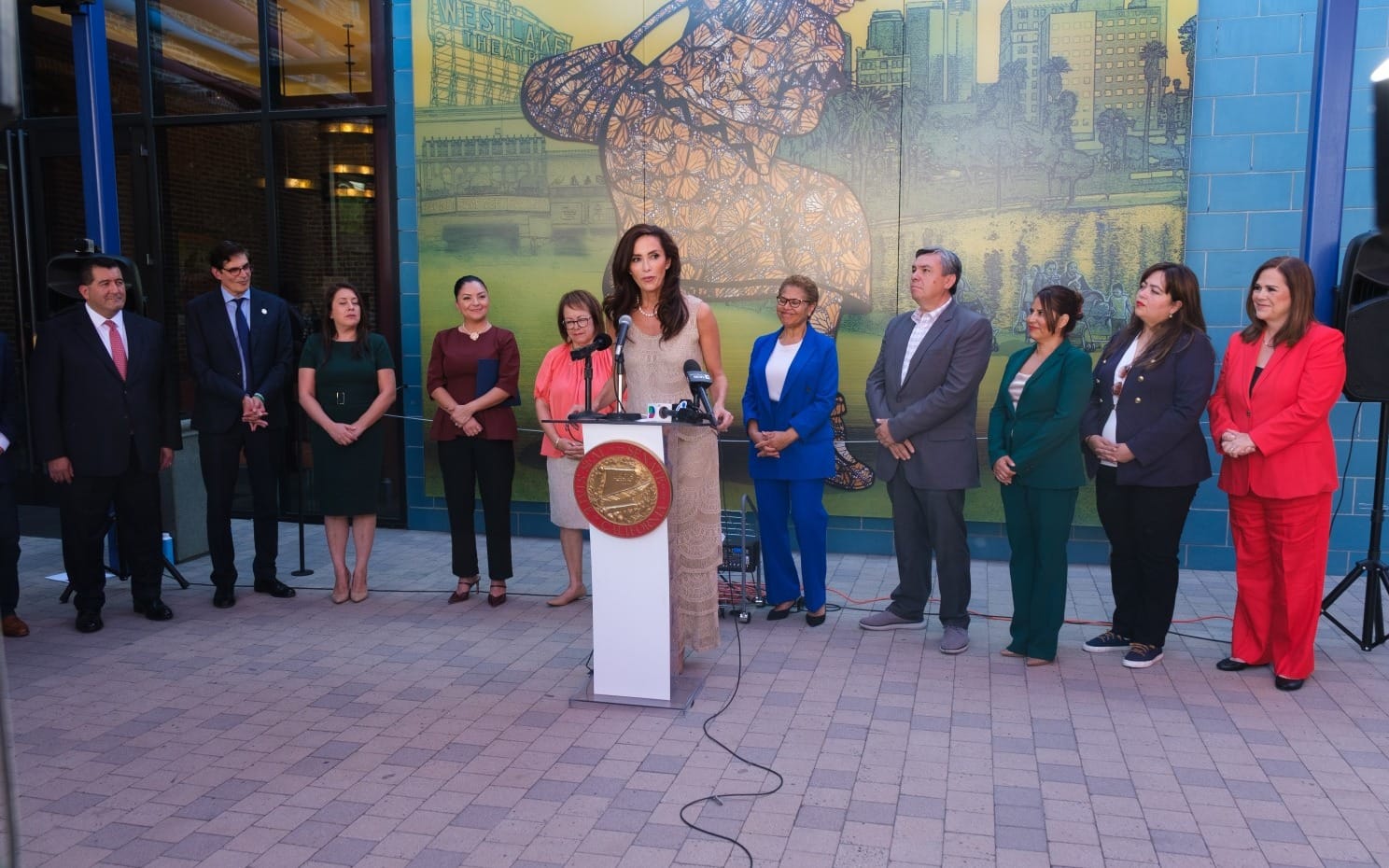
On October 24, 2024, in a room in Los Angeles, elected officials, philanthropists, and community leaders stood together to launch the Mexican Repatriation Memorial Project. Among them: Claudia Romo Edelman, Richard Edelman, Martin Cabrera Jr., Benjamin Cardenas, state Senator Josh Becker, and Los Angeles Mayor Karen Bass. I was in that room, and what I witnessed named a debt this country has yet to pay.
Illustration © 2026 Latino Professionals® Magazine. Creative Direction by Jennifer Montoya | Final Art Direction by Studio Café Canela | Rafael Magaña, Editor-in-Chief. All rights reserved. / ©Latino Professionals Images. All Rights reserved.

During the Great Depression, nearly one million Mexican Americans — many of them U.S. citizens — were forced out of the country in a campaign known as the Mexican Repatriation. The justification offered at the time was economic: the nation needed jobs, and Mexican Americans, blamed for a shortage they had not caused, paid for it with their homes and their families. For nearly a century, the story stayed out of classrooms and out of city halls.

That the memorial exists at all traces back to a school assignment. Tamara Gisiger, a young Latina student, took on the kind of research project every student is handed and found something the textbooks had left out. She could not attend the launch. Her mother, Claudia Romo Edelman, spoke in her place.


"This memorial," Romo Edelman said, "is more than just a tribute to those who suffered during the Mexican Repatriation. It is an homage to the power of young leaders like Tamara, who are unafraid to challenge the status quo and seek justice for those who have been silenced."
Mayor Bass framed the memorial as an argument about what leadership requires. "This memorial is a tribute to the endurance and perseverance of the Latino community," she said. "It's also a stark reminder that our history is one of resilience, and by acknowledging it, we build a future where such injustices are never repeated. Leadership means remembering and learning from the past to shape a more just and equitable future."
Behind the ceremony sat months of legislative work. State Senators Lena Gonzalez and Josh Becker pushed the project through the channels where memory becomes policy — the approvals and the paperwork that turn a wrong into a permanent marker instead of a story passed down quietly inside families. It is slower work than a speech, and it draws no crowd of its own. It is also the difference between an idea and a monument that will still be standing after the people who remember firsthand are gone.
I saw in Tamara something I hope to see repeated. She is a shining example of how the younger generation can impact the future by remembering the past. She embodies what rising Latinas are capable of: pushing boundaries, raising awareness, and advocating for justice. Her work proves that even one voice can make a difference.

As Claudia Romo Edelman so powerfully stated,
“This memorial is a vital step in bringing their stories to light and continuing the journey toward justice, healing, and remembrance.”
A memorial does not undo what happened in the 1930s. No memorial does that work. What it does is put a name and a place to a history this country tried to forget, and hand the next generation — the Tamaras still sitting in classrooms right now — proof that a research paper can become a public reckoning. That was the argument being made in that room in Los Angeles on October 24: memory is not nostalgia. It is a form of leadership, and it points our community forward


Event Host
The Office of California State Senator Josh Becker, representing the state’s 13th Senate District, co-hosted this launch with Senate Majority Leader Lena Gonzalez under Senate Bill 537, the legislation the two senators authored to fund a public memorial to victims of the Mexican Repatriation. The Mexican Repatriation Memorial Project launch was held October 24, 2024, at La Plaza de Cultura y Artes in Los Angeles.
Reported and written by Rafael Magaña, Founder & Publisher, for Latino Professionals Magazine. → Full archive
RECORD №00112 · MMXXVI · Latino Professionals Magazine
Published by Latino Professionals Media Group.
Documenting the people, ideas, and institutions shaping American business.